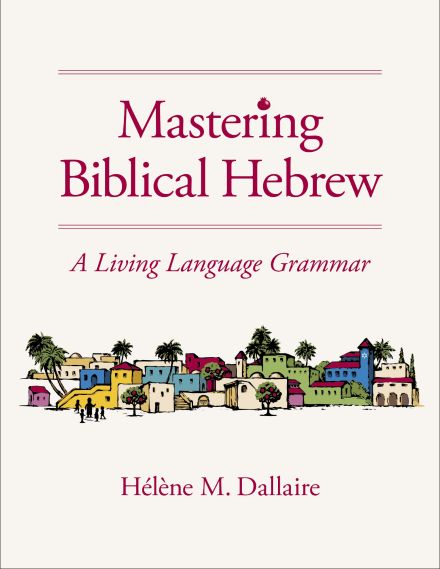
Hélène M. Dallaire discusses Mastering Biblical Hebrew

HÉLÈNE M. DALLAIRE (PhD, Hebrew Union College-Jewish Institute of Religion) is Earl S. Kalland Professor of Old Testament and Semitic Languages and Chair of the Old Testament Department at Denver Seminary.
ZA: You’ve been teaching Hebrew for many years. What drives your passion for the language?
HÉLÈNE M. DALLAIRE: My passion for Biblical Hebrew springs from both personal experience and deep professional conviction. Years ago, I studied Modern Hebrew and Arabic in Israel through an immersive, joyful approach that transformed how I view language learning, especially for ancient languages like Biblical Hebrew. I realized language is best learned holistically—through listening, speaking, reading, writing, and performing the text. This insight inspired me to bring that same vitality into my Hebrew classes, both residential and online.
I have applied Second Language Acquisition methods, Total Physical Response, performative learning, and visual engagement with rabbinic students at Hebrew Union College and developed a living language approach for students in Israel, the Philippines, India, and the USA. Today, I am deeply driven by seeing students engage with the Hebrew Bible not as a code to decode, but as a living, breathing text to experience. Watching students delight in “aha” moments as they explore the text with passion is truly exhilarating. My goal is to make the language accessible, immersive, and spiritually enriching—helping students connect beyond grammar to the vibrant world of the Bible and its original Hebrew.
ZA: What makes your Mastering Biblical Hebrew a “living language” grammar?
HÉLÈNE M. DALLAIRE: Mastering Biblical Hebrew as a “living language” grammar means treating it not as a static set of rules to memorize but as a vibrant, communicative language to experience. This approach is grounded in oral storytelling, physical interaction, and performative learning mimicking how we acquire our first language. In every chapter, students engage in listening, speaking, reading, and writing activities using Biblical Hebrew. The textbook introduces the Hebrew Bible itself as the primary learning text from chapter one, anchoring grammar and syntax instruction in authentic biblical material.
Unlike traditional deductive and grammar-translation methods, this book encourages learners to speak, sing, act, play games, and use real objects in creative classroom activities—without neglecting the linguistic and rhetorical richness of the language. Instructors are encouraged to adapt and create activities tailored to their students’ needs and academic contexts. The textbook also supports learners with a wide range of media, including teaching videos, visual vocabulary tools, AI-generated exercises (texts, images, videos), and audio recordings. Whether in classroom, live online sessions, or self-study, this grammar fosters immersive, joyful learning that makes Biblical Hebrew feel alive, relevant, and deeply engaging.
ZA: How will Mastering Biblical Hebrew help students succeed?
HÉLÈNE M. DALLAIRE: Mastering Biblical Hebrew prepares students for exegesis by guiding them through the biblical text line-upon-line, precept-upon-precept, here a little and there a little, in an engaging and dynamic way until they are ready to explore longer, more complex pericopes. The textbook equips students for advanced study by integrating Hebrew syntax, textual criticism, and an introduction to Hebrew poetry. The final four chapters lead students through an exegetical study of Genesis 1–3, offering opportunities to exegete the text by answering comprehension questions in Hebrew.
My book appeals to diverse learning styles: visual learners benefit from image-based exercises; auditory learners practice with audio files and oral commands; social learners engage through role-play and peer activities; and analytical learners delve into grammatical and syntactical features. Ancillary materials like teaching slides, answer keys, and digital tools support learners in reinforcing concepts at their own pace, whether in classroom, online, or independent study. Former students using this approach have succeeded in doctoral programs and now teach Biblical Hebrew in many academic settings. This grammar not only teaches content but also cultivates confident, curious, and proficient readers of the Hebrew Bible.
Thank you! Sign up complete.