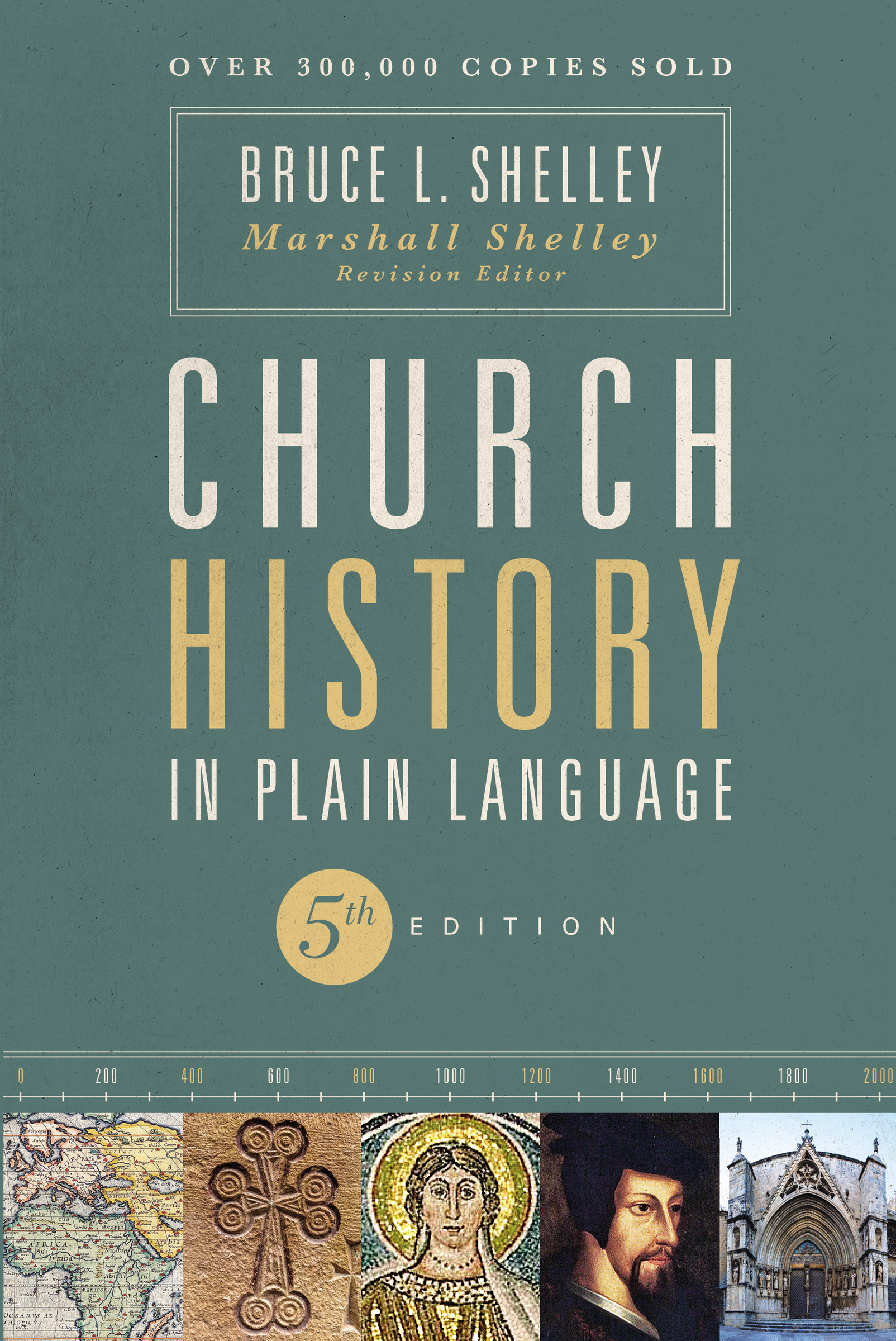
Church History in Plain Language, Fifth Edition

Description
Over 330,000 copies sold. This is the story of the church for today's readers.
Bruce Shelley's classic history of the church brings the story of global Christianity into the twenty-first century. Like a skilled screenwriter, Shelley begins each chapter with three elements: characters, setting, plot. Taking readers from the early centuries of the church up through the modern era he tells his readers a story of actual people, in a particular situation, taking action or being acted upon, provides a window into the circumstances and historical context, and from there develops the story of a major period or theme of Christian history. Covering recent events, this book also:
- Details the rapid growth of evangelical and Pentecostal Christianity in the southern hemisphere
- Addresses the decline in traditional mainline denominations
- Examines the influence of technology on the spread of the gospel
- Discusses how Christianity intersects with other religions in countries all over the world
For this fifth edition, Marshall Shelley brought together a team of historians, historical theologians, and editors to revise and update this father's classic text. The new edition adds important stories of the development of Christianity in Asia, India, and Africa, both in the early church as well as in the twentieth and twenty-first centuries. It also highlights the stories of women and non-Europeans who significantly influenced the development of Christianity but whose contributions are often overlooked in previous overviews of church history.
This concise book provides an easy-to-read guide to church history with intellectual substance. The new edition of Church History in Plain Language promises to set a new standard for readable church history.
Table of Contents
Part 1: The Age of Jesus and the Apostles, 6 BC – AD 70
- Chapter 1: Away with the King! The Jesus Movement
- Chapter 2. Wineskins Old and New: The Gospel to the Gentiles
Part 2: The Age of Catholic Christianity, 70–312
- Chapter 3. Only “Worthless” People: Catholic Christianity
- Chapter 4. If the Tiber Floods: The Persecution of Christians
- Chapter 5. Arguing about the Event: The Rise of Orthodoxy
- Chapter 6. The Rule of Books: Formation of the Bible
- Chapter 7. School for Sinners: A Structure That Fits
- Chapter 8. Apostles to Intellectuals: Interacting with Other Worldviews
- Chapter 9. Countries of the Sunrise: Early Christianity in Asia and Africa
Part 3: The Age of the Christian Roman Empire, 312–590
- Chapter 10. Laying Her Sceptre Down: Conversion of the Empire
- Chapter 11. Splitting Important Hairs: The Doctrine of the Trinity
- Chapter 12. Emmanuel! Christ in the Creeds
- Chapter 13. Exiles from Life: Beginnings of Monasticism
- Chapter 14. The Sage of the Ages: Augustine of Hippo
- Chapter 15. Peter as “Pontifex Maximus”: Beginnings of the Papacy
- Chapter 16. Somewhere between Heaven and Earth: Eastern Orthodoxy
- Chapter 17. Bending the Necks of Victors: Mission to the Barbarians
Part 4: The Christian Middle Ages, 590–1517
- Chapter 18. God’s Consul: Gregory the Great
- Chapter 19. The Search for Unity: Charlemagne and Christendom
- Chapter 20. Lifted in a Mystic Manner: The Papacy and the Crusader
- Chapter 21. The Nectar of Learning: Scholasticism
- Chapter 22. A Song to Lady Poverty: Francis and the Apostolic Lifestyle
- Chapter 23. Chaos and the Law of Necessity: Decline of the Papacy
- Chapter 24. Judgment in the Process of Time: Wyclif and Hus
Part 5: The Age of the Reformation, 1517–1648
- Chapter 25. A Wild Boar in the Vineyard: Martin Luther and Protestantism
- Chapter 26. Radical Discipleship: The Anabaptists
- Chapter 27. Thrust into the Game: John Calvin and Reformed Rule
- Chapter 28. The Curse upon the Crown: The Church of England
- Chapter 29. “Another Man” at Manresa: The Catholic Reformation
- Chapter 30. Opening the Rock: Uttermost America and Asia
- Chapter 31. The Rule of the Saints: Puritanism
- Chapter 32. Unwilling to Die for an Old Idea: Denominations
Part 6: The Age of Reason and Revival, 1648–1789
- Chapter 33. Aiming at the Foundations: The Cult of Reason
- Chapter 34. The Heart and Its Reasons: Pascal and the Pietists
- Chapter 35. A Brand from the Burning: Wesley and Methodism
- Chapter 36. A New Order of the Ages: The Great Awakening
Part 7: The Age of Progress, 1789–1914
- Chapter 37. Restoring the Fortress: Catholicism in the Age of Progress
- Chapter 38. A New Social Frontier: Nineteenth-Century England
- Chapter 39. To Earth’s Remotest People: Protestant Missions
- Chapter 40. The Destiny of a Nation: A Christian America?
- Chapter 41. A Bridge for Intelligent Moderns: Protestant Liberalism
- Chapter 42. Nothing to Lose but Chains: Slums and the Social Gospel
Part 8: The Age of Ideologies, 1914–1989
- Chapter 43. Graffiti on a Wall of Shame: Twentieth-Century Ideologies
- Chapter 44. Rootless Immigrants in a Sick Society: American Evangelicals
- Chapter 45. New Creeds for Breakfast: The Ecumenical Movement
- Chapter 46. The Medicine of Mercy: Roman Catholicism and Vatican II
Part 9: The Age of Technology and the Spirit, 1990–
- Chapter 47. New Technologies, New Contexts: Christian Ministries in the West
- Chapter 48. More Peoples, More Tongues: Emergence of the Global South
From the Prologue
Many Christians today suffer from historical amnesia. The time between the apostles and our own day is one giant blank. That is hardly what God had in mind. The Old Testament is sprinkled with reminders of God’s interest in time. When he established the Passover for the children of Israel, he said, “Tell your son . . . it will be like a sign . . . that the Lord brought us out of Egypt” (Ex. 13:8, 16). And when he provided the manna in the wilderness, he commanded Moses to keep a jar of it “for the generations to come” (Ex. 16:33). As a consequence of our ignorance concerning Christian history, we find believers vulnerable to the appeals of cultists. Some distortion of Christianity is often taken for the real thing. At the same time, other Christians reveal a shocking capacity for spiritual pride, hubris. Without an adequate base for comparison, they spring to the defense of their way as the best way, their party as the superior party. Finally, many Christians engage in some form of ministry without the advantage of having a broader context for their labor. When they want to make the best use of their time and efforts, they have no basis for sound judgment. I am not suggesting that one book surveying our Christian past will refute all error, make the reader a humble saint, or plot a strategy for effective ministry. But any introduction to Christian history tends to separate the transient from the permanent, fads from essentials. That is my hope for this book among my readers. The book is designed for laypeople. We all know that term is made of wax; we can twist it to suit our tastes. After four decades of teaching first-year seminarians, I have concluded that college graduates entering the ministry and an engineer or a salesperson who reads five books a year are members of the same reading public. For my purposes here, both are laypeople.
In preparation for classes, a professor digests hundreds of books and accumulates thousands of quotations. In this survey volume, I have borrowed freely from the ideas and descriptions of others, while working with a simple aim: keep the story moving. I have tried to corral all of these resources and list the most helpful books at the end of each chapter and cite my major quotations in the notes at the end of the book.
From years of teaching, I have also concluded that clarity is the first law of learning. So the divisions of the subject are all here. We call them ages because the conditions of the church’s life change. Great eras, I know, do not suddenly appear like some unknown comet in the skies. In every age, we find residue of the past and germs of the future. But if the reader wants to get the plot of the story, all he or she has to do is to read the paragraphs on the title pages of the major divisions. This device is important for unity, I feel, because each chapter is arranged in a certain way. Only one issue appears in each. The reader can find it, in the form of a question, after an introduction to the chapter. The introduction is usually some anecdote from the time. This means that each chapter is almost self-contained and could be read in isolation, almost like an encyclopedia article on the subject.
Taking this “issues” approach admittedly leaves plenty of gaps in the story. Some readers will wonder why certain important people or events are not included. But this approach has the advantage of showing to the layperson the contemporary significance of church history. Many of today’s issues are not unique. They have a link with the past.
Finally, some readers may wonder about the amount of biographical material. Why so many personal stories? Again, the answer is communication. Without ignoring ideas, I have tried to wrap thoughts in personalities because I assume most readers are interested in meeting other people.
Church historians often ask, “Is the church a movement or an institution?” These pages will show that I think it is both. So I talk about missionary expansion as well as papal politics. Professionals in the field may not be happy with my failure to set limits by a strict definition of the term church. But that fuzziness is because I believe the people of God in history live in a tension between an ideal—the universal communion of saints—and the particular—the actual people in a specific time and place.
The church’s mission in time calls for institutions: special rules, special leaders, special places. But when institutions obstruct the spread of the gospel rather than advance it, then movements of renewal arise to return to the church’s basic mission in the world. These pages will illustrate how often that has happened.
—Bruce L. Shelley